Why this Activity?
Rural Oregonians innately understand the necessity of neighbors helping neighbors. The devastating budget bill that just passed the House is a continuation of what we saw from Trump’s first 100 days: systematically slashing funds and eliminating services that our communities rely on to pad the pockets of billionaires. Now is a moment we lean further into our networks and call on our neighbors to Build Alternatives to take care of one another and meet our basic needs. Mutual aid is one of those essential lifelines.
Mutual aid (sharing resources and building our own collective systems of care) has always been necessary for the survival of systematically excluded folks in this country who cannot rely on federal or state-operated systems. Rural communities face defunded programs or a sheer lack of necessary services in the best of times and are now bracing for it to get a lot worse. For centuries, queer, trans, BIPOC, and disabled folks have been organizing systems of collective care that offer a vision for a world built around safety and health for all of us.
Human Dignity Groups, focused on community solidarity through mutual aid, have been providing food, medical, and basic needs assistance since the height of the pandemic. Mutual aid is also a “powerful tool against authoritarianism,” as described by Scot Nakagawa, that is crucial as we build power to organize resistance movements for the long haul.
Maxfield Sparrow, a multiply disabled writer, artist, and composer, shares, “Mutual aid begins wherever two or more people decide to show up for each other,” in their blog A Mind Unstrange. Connecting around food, safety, and essential needs is a great place to start building alternatives and the capacity of our networks to build safe and thriving communities.
What is the Activity?
This month’s KTA is to make a plan with your group to bring folks together and build alternatives to keep each other safe and resourced to resist fascism in the spirit of mutual aid.
At the Rural Caucus and Strategy Session in April, 30 of us gathered in a packed room to talk about the history of mutual aid and disability justice organizing. At one point, the conversation turned to preparing for fire season, and the way that neighbors helping neighbors can offer a bridge across political divides.
Lee Curran, a human dignity leader in Klamath County with Community Action Coalition, shared how the increased risk of wildfires led to a recent effort to identify disabled community members who will need direct assistance for evacuation. Leaders from South County Collective Action in La Pine took inspiration from this and planned to take it back to their group to plan for fire season.
Eliot Feenstra, a human dignity leader from Josephine County, shared how last summer, their community made a concerted effort to create phone trees so that in the case of a disaster, they would be able to check on each other and help with evacuation needs because they knew emergency services wouldn’t be quick enough. First, they tried sending out a survey over email to everyone in the community. But no one filled it out (if your inbox looks anything like ours, you probably aren’t surprised by this!). So the organizers pivoted: they organized a series of local community potlucks, bringing people together for good company and good food. At those potlucks, they went around and asked folks if they wanted to share their phone number to be part of a neighborhood phone tree – THIS was more effective and added the relational focus on getting to know neighbors.
How to Complete the Activity:
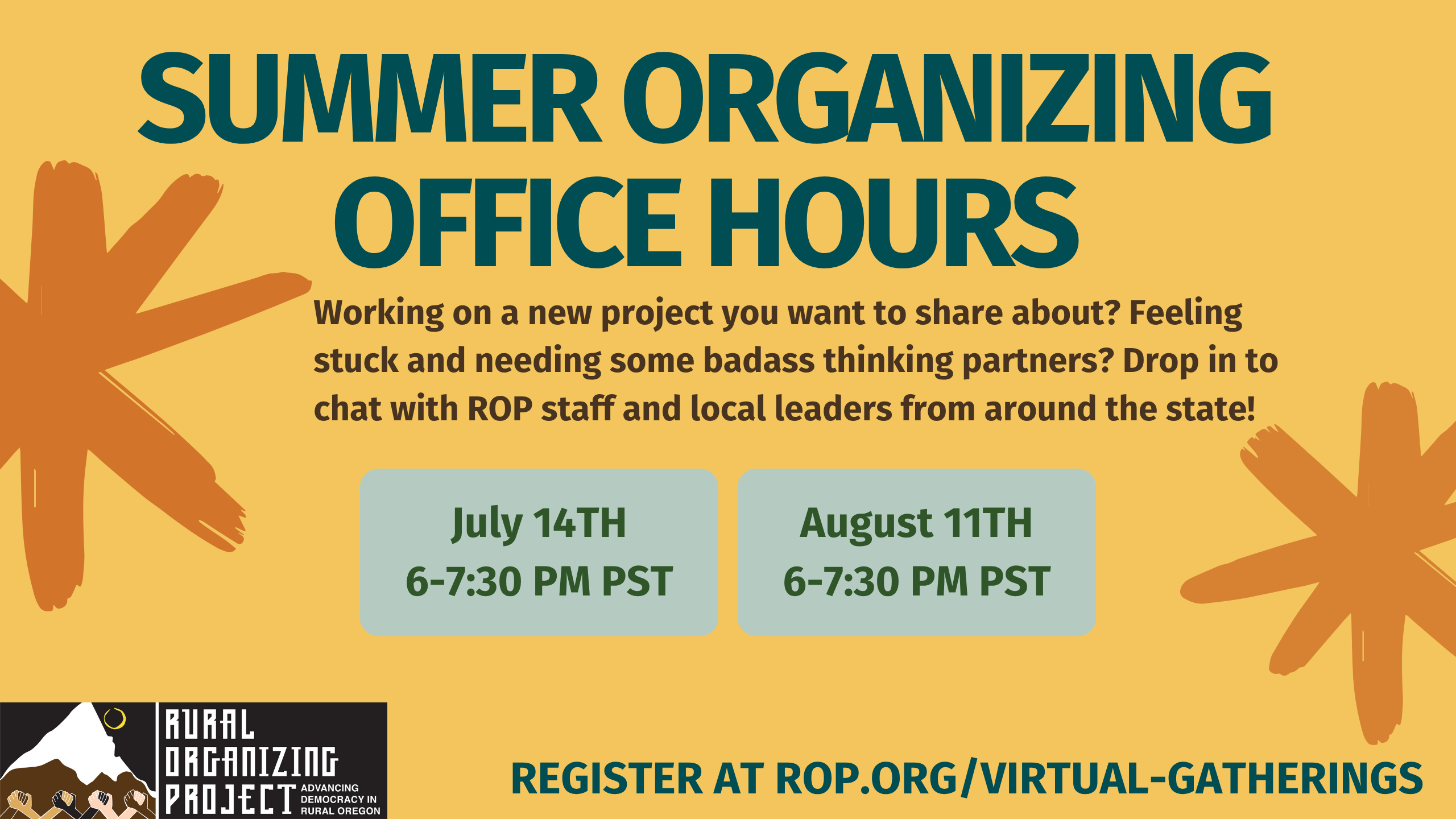
- Join ROP’s office hours on Monday, July 14th for support in making your plan to complete this KTA or to chat about anything else coming up in your local organizing! Register here.
- Meet with your leadership team to discuss where this latest attack on services and infrastructure will be most felt in your community. Take some time to check in with each other and how this news is hitting each of you personally, too. What do you each need or have to offer in this moment?
- Choose a particular concern that’s feeling most pressing. Is it fire preparedness? Access to health care? Something else? Whatever it is, how could your group help the community build alternatives by being more connected with one another? Maybe the phone tree will include who has access to a car and is willing to drive people to appointments.
- Plan how you will reach out to your neighbors and bring them in. Do you want to host a potluck where folks have the opportunity to be added to the neighborhood phone tree? Do you want to go door to door? Either way, you’ll want sign-in sheets!
- Need help planning your event? Want to start a group or connect with an existing one? Reach out to your ROP organizer or email sidra@rop.org.
Extra credit: Explore Mutual Aid 101: Solidarity, Survival, and Resistance – an introductory toolkit for mutual aid organizing that outlines starting a group and sustaining for the long haul.
Background: Kitchen Table Activism (KTA) is a monthly activity by the Rural Organizing Project. The idea is that small actions can lead to powerful collective results when groups of people gather to complete the same action across the state of Oregon. ROP works to keep each KTA easily achievable so that groups with other projects or groups with limited immediate energy can still complete the KTA each month.